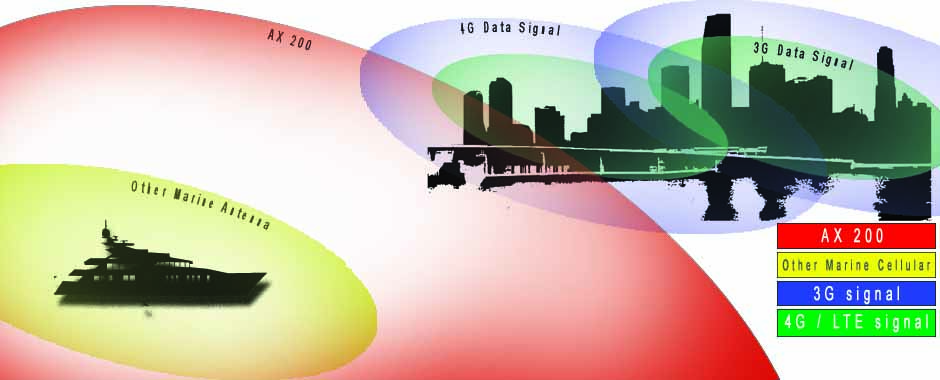
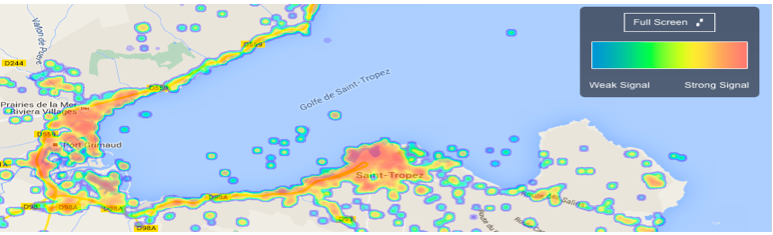
Axxess Marine understands how important it is that our clients get the best service possible on vessels. Given that vessels are mostly located in areas that are not directly covered by cellular signal, cellular antenna gain is supremely important.
Further, the connectivity between a router and its cellular network is key and given that cell towers generally push service to land rather then water- and impediments such as distance from cell towers can negatively impact client’s reception, Axxess has been developing a better, stronger, faster solution for our clients to ensure the best cellular reception possible.
The NEW Axxess Marine AX200 is a marvel in performance, design and quality. With its high gain of 14dBi it outperforms other antennas on the market. While other antennas have an average gain of 1.5 – 4 dBi on the mid range frequencies, the AX200 has a gain of up to 14.6 in the mid range frequencies.
The Axxess Marine AX200 High Gain Antenna will make its debut at the FLIBS boat show in Fort Lauderdale November 4th through 10th. Initial quantities are limited and preorders are recommended.
To find out more about the Axxess Marine AX200 High Gain Antenna, contact Dennis for details or book an appointment to visit us at the show by emailing andrea@axxess-marine.com.
Want to know more about cellular reception? Take a look at the simple primer the Axxess Marine tech team has created.
Cellular Reception: The Basics from Axxess Marine
Cellular Router: Two-way wireless communication device that needs both the inbound signal (reception) and the outbound signal (transmission) to work.

Signal Strength: The power of the received signal from the cell tower. The signal strength on your vessel is indicated by the ‘bars or –dBi’ on your cellular router.
Antenna output performance is measured by dBi and referred to as “gainâ€
The connectivity between a router and its cellular network depends on both reception and transmission signals.
Signal strength on your vessel is affected by many factors, such as the distance between the router and the nearest cell tower, the number of impediments between them and the wireless technology (e.g. GSM vs. CDMA).
Poor reception (fewer bars / Lower -dBi) normally indicates a long distance and/or much signal interruption between the router and the cell tower.
Cable length between the router, type of connectors, number of adapters and the antenna quality contributes to a large part of the “loss†on the routers service.
Higher Gain antenna will compensate in the loss created on long cable runs. A 40-50FT LMR 400 has an average loss of 2.5dBi. A 14dBi AX 200 antenna will have a positive input on the router of 11.5dBI.
GSMs, (Global Service for Mobile communication Providers) tune cell towers to push service to the areas where the highest number of clients reside and this is not on the water. Vessels do get reception from cell towers but quality routers and higher gain antennas are very important to get the best cellular reception and make the most of the provided signals.