The Axxess Marine team is always looking to provide better technology and service to our customers. To do that we need to be constantly educating ourselves- and using that knowledge to keep our clients abreast of the best and newest applications and equipment. With that in mind, I am posting the second of two great blogs by Denis Sutherland, Sr. Manager, Sales System Engineering, originally posted on his blog last year. They are both great articles and well worth the read…
Looking forward to seeing everyone at Monaco Yacht Show September 23-26th! Cheers Andrea
Antenna Size Does it Really Matter?
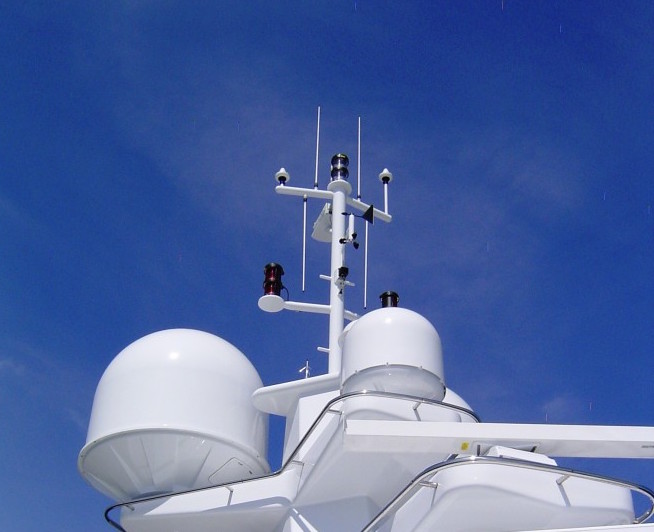
One key question that customers of satellite service providers will ask is if Ka band allows them to use smaller terminals, or higher data rates from a reflector of the same size. This is a very attractive proposition to most satellite users, especially if size or weight is a consideration, usually for many military applications.
The reflector will be smaller because of the nature and physics of satellite communications. For an equivalent performance, Ka Band typically would require a smaller reflector due to smaller wavelengths and can be used by bands of a higher frequency. Many equipment manufacturers have been developing smaller Ka band terminals. Kymeta is one company that is pushing on with flat panel development with some exciting plans.
I hear some people say a terminal is more than a reflector; the other antenna components are more complex like filters and that Ka filter component is newerand thus not as small as KU, where years of development may have resulted in miniaturization. I will be very curious to see Ka terminals coming onto the market with SWaP smaller than Ku in the short term.
Another factor is that prices on the Ka Band ODU have not seen the low levels that years of manufacturing and competition have brought with KU Band. This will undoubtedly change as more Ka Band vendors jump on the bandwagon.
Have you considered the implications of the very large spectrum to Ka terminals vendors, and how they may need to build more than one type of Ka terminal to cover the entire band?
The range of Ka-Band is much wider than in Ku-Band. Ka-Band Satellites dependent on their orbital filings can be located anywhere on that spectrum scale. Commercial payloads can be almost anywhere from 27.5-30.0GHz uplink and then there is military band as well of 30.0-31.0GHz. It’s is impossible to cover entire 2.5GHz commercial span with L-band or single ODU. Some payloads cross 500MHz boundaries. That also means Service Providers would have to buy a larger range of ODU equipment in stock dependent on which satellite coverage they are using for their services in different regions.
Coming from Scotland I know all about rain fade! As I grew up, I could see the oil platform in the North Sea from my bedroom window, or more often from the golf course along the shore. So I know how quickly weather conditions can change in these types of environments, and I think it is one that is critical to the success or failure of the HTS model, but also one where innovation by VSAT vendors such as iDirect will make a big difference.
On the rain-fade and ODU side, the susceptibility to rain fade is much less on C band more in Ku and it can be quite drastic on Ka band. This needs to be taken into account, mitigated with the use of ACM on the outbound and further improved in iDX3.2 including Adaptive TDMA on the inbound.